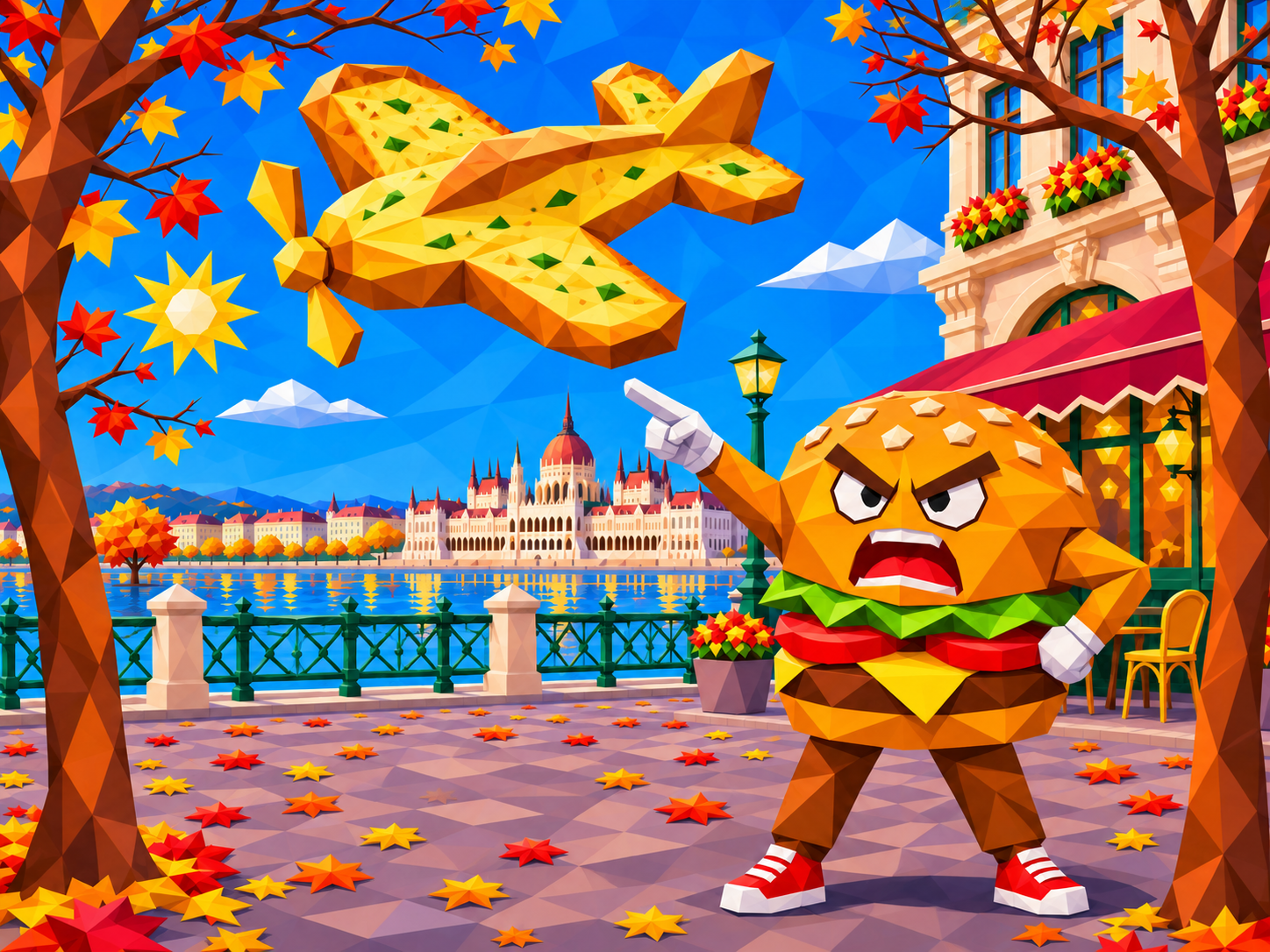
Welcome to Plancha Express. This week, a Budapest burger bar turns public affairs into queues, a Bucharest institution invents customers who skip the bill, delivery apps illustrate dishes nobody cooked, and Vienna offers a reminder: being famous makes marketing considerably easier.
The burger bar whose staff asked for less marketing
Budapest’s Billog Burger has opinions about teachers being dismissed, violence against women, Pride, political corruption and generally on whatever is making the news.
Its "Palya Burger" supported a dismissed teacher. When a Roma barber’s shop was vandalised with a racist insult, Billog put the same word on its own storefront in solidarity. Its Angel Shot initiative gives guests who feel unsafe a discreet way to ask staff for help.
Marketing lead László Szilágyi responds to stories people already care about, giving them a reason to notice Billog beyond another photograph of melted cheese.
The response has, at times, exceeded the kitchen’s capacity.
“At one point, the place got so busy we couldn’t keep up,”
Szilágyi says. Staff could barely take bathroom breaks. Eventually, they asked him to stop.
Attention became customers, and customers became an operational problem. There are no sales figures here to calculate the return, but a team asking for less marketing because they cannot keep up with demand is a more meaningful signal than a post’s reach on Instagram.
Taking positions also means accepting that some people will dislike you. Billog’s approach depends on convictions it repeatedly acts on, and staff prepared to deliver the service behind them. Borrowing the provocation without either would be a different business.
The customers who didn’t steal your dinner
Bucharest’s Casa Doina tried another route: inventing an injustice.
An August Instagram carousel opened with a message to two young lovers who had supposedly left without paying. Subsequent slides showed their food and drinks, from mici to Aperol Spritz. The final slide revealed that the couple did not exist. The restaurant just wanted to show its menu.
Our Romanian contributor had already seen the same routine twice that day, following the same script: a restaurant pretending they were robbed by “dine-and-dashers”, as they are called, as a pretext to show what’s new on their menu. And when everybody does it, it’s not quirky, it’s desperate.
Casa Doina is a Bucharest institution, serving Romanian food in an Ion Mincu building. It has an actual history to draw on. Nevertheless, somebody decided the missing ingredient was imaginary petty crime.
The weakness is in the transaction with the reader. You ask them to care about your business being mistreated, then reveal that their sympathy was the mechanism for getting them through a menu carousel.
Perhaps they laugh. Perhaps they feel slightly stupid for caring. Neither feels like a surefire way to get them to book a table.
Business class of the Garlic Bread Plane
With AI pictures, the invented part can be the food itself.
Just Eat’s image trial turned a soda-bread breakfast into bacon and eggs floating in a fizzy drink. A menu typo, “garlic bread plane”, produced an aircraft made of bread. The company apologised and paused the rollout.
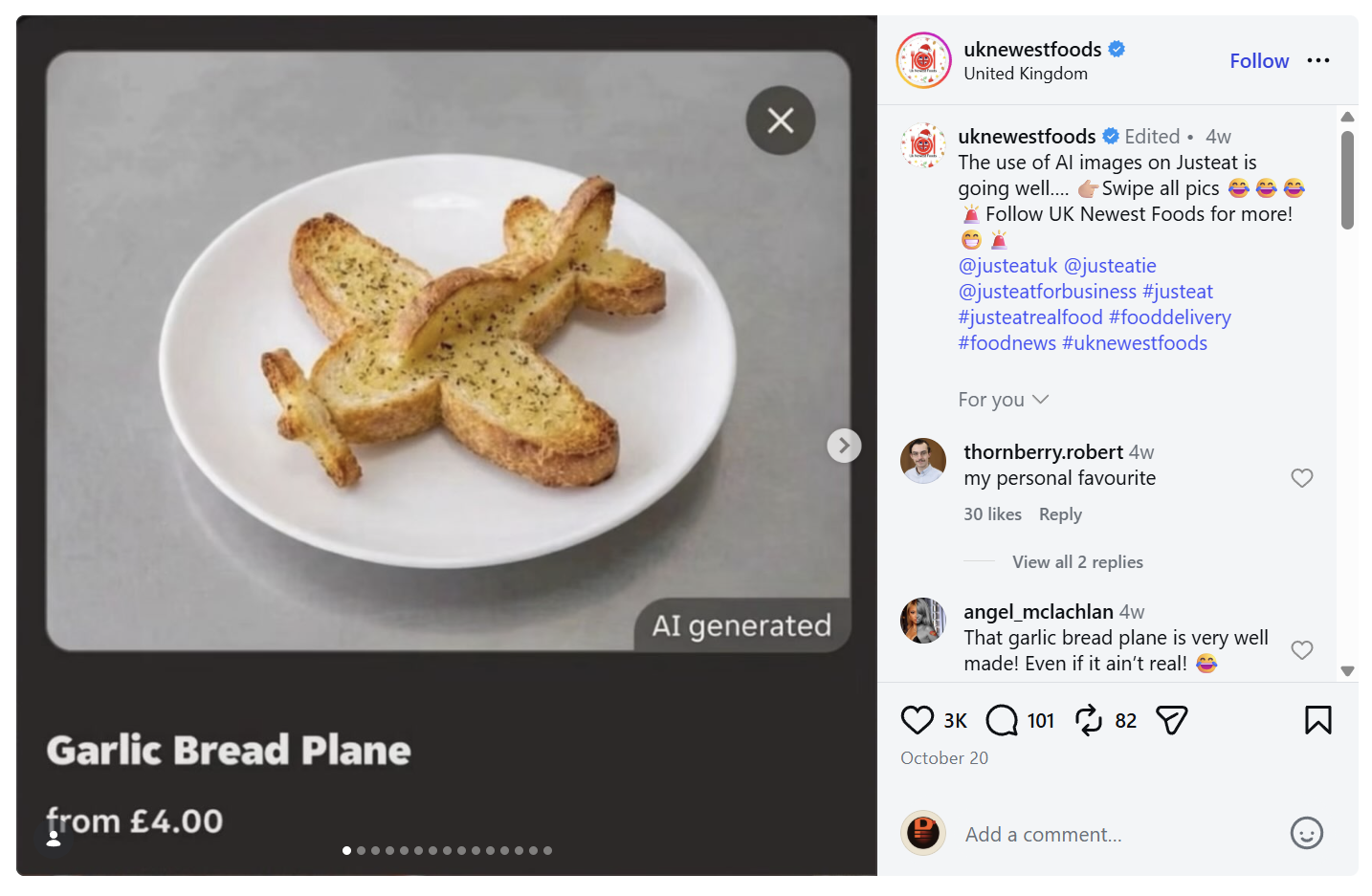
The pictures are funny, but the sales effects are more interesting.
After India’s Zomato banned AI-generated dish images in August 2024, Carnegie Mellon researchers compared its restaurants with those on Swiggy, which continued allowing them. Their working paper estimates a 10.4% increase in orders and 9.3% in revenue relative to Swiggy following the ban.
This is evidence from one market and a platform-wide policy change, not a promise that replacing your burger picture will lift sales by 10%. The researchers also cannot directly identify every restaurant’s AI use. Still, it is useful evidence that cheaper image production can carry a commercial cost.
For operators, there is a practical distinction between improving a photograph and inventing the plate. Wolt’s Hungarian merchant guide explicitly rejects AI-generated images while offering AI tools to adjust real photographs. It also requires images to match the actual dish and portion.
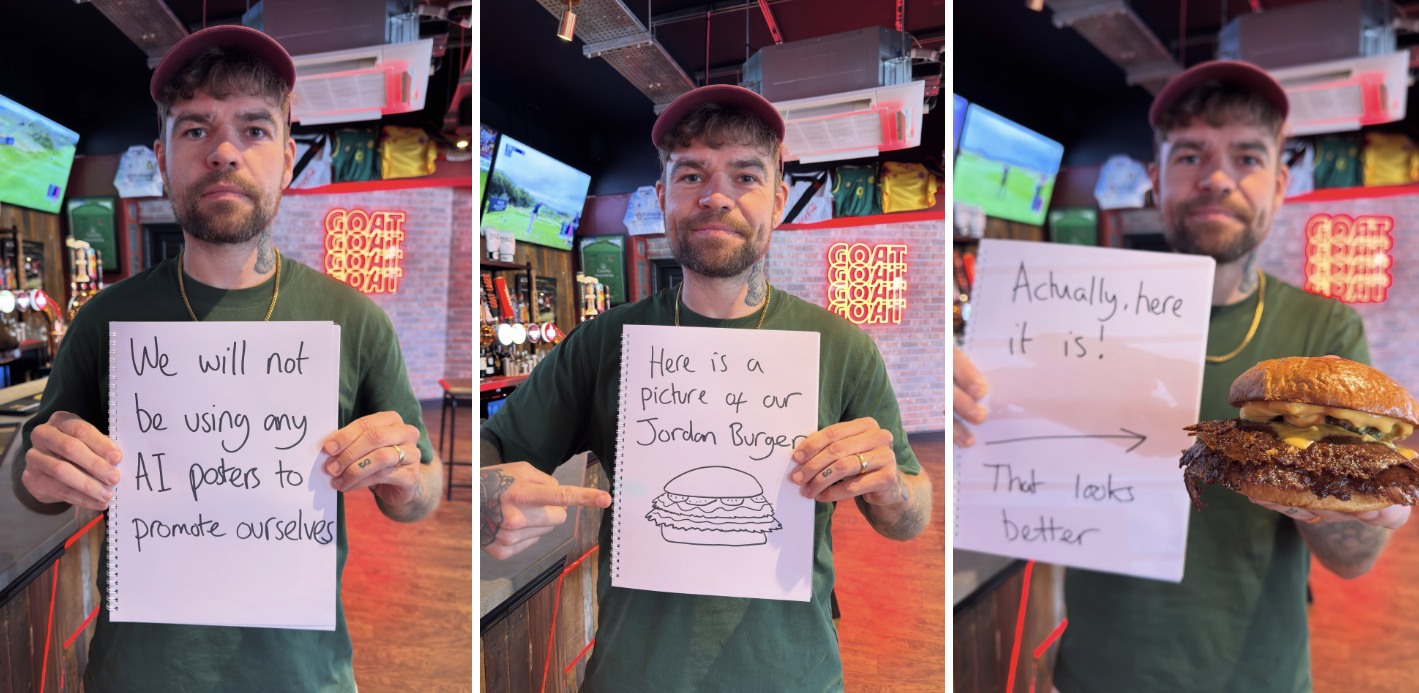
Some businesses have made the opposite aesthetic their campaign: handwritten signs, a deliberately poor drawing, then the real food. GOAT in Nantwich used the format to show its burger. The joke works because the kitchen can deliver the punchline.
First become Bob Dylan
Alexei went to see Bob Dylan in Vienna. Dylan played without introducing the songs or his band. Audience engagement was apparently somebody else’s problem.
At 85, and with a Nobel Prize to his name, Dylan can obviously afford to do whatever he likes. But that got Alexei thinking: when do you know you have crossed the line into legend and simply let your name do the advertising for you?
And this legendary status – whose doing is it, exactly? Yours or your publicist’s? You may be the talent, but who tells your story? Closer to Plancha’s area of expertise, can any new restaurant or cafe (or indeed any emerging business) afford to ignore social media or advertising?
The old guard certainly seems to manage. Café Jelinek, a Vienna institution, has zero SMM ambitions, but then again it is a bit like Bob Dylan: creaky yet special. Grafisches Büro, one of Vienna’s earliest graphic design studios, which created the visuals for Martin Auer’s RYE in New York, has no social media presence of its own. Neither does Monocle, the magazine Alexei works for (unless you count LinkedIn or X).
But then there’s another venerable Viennese coffeehouse, Eiles: not only does it have Instagram, but produces its own podcast, featuring some of the biggest names in Austrian politics and entertainment. Lukas Mraz, the son in the Michelin-starred Mraz & Sohn, seems to be on every Austrian foodie YouTube video and podcast going. Is this the way forward? Or should we all take the Dylan approach?
(Interestingly, Dylan does have an Instagram account but it’s about as welcoming to visitors as his onstage demeanour).

The line talks back