
People are asking AI where to eat. Attest’s 2025 consumer AI report found that 13.5 percent of consumers ask AI for restaurant, bar, hotel and attraction recommendations. BrightLocal’s 2026 Local Consumer Review Survey found that use of ChatGPT and other AI tools for local business recommendations jumped from 6 percent in 2025 to 45 percent in 2026.
But visibility is not trivial: Local Falcon’s restaurant study, based on 189,905 ChatGPT search results, found that 83 percent of restaurants were completely invisible on ChatGPT, compared with 14 percent on Google.
Google rankings may be crowded, incremental and annoying, but AI recommendations are narrower: five names, sometimes fewer. You are either in the answer or you are not.
So we ran a small test.
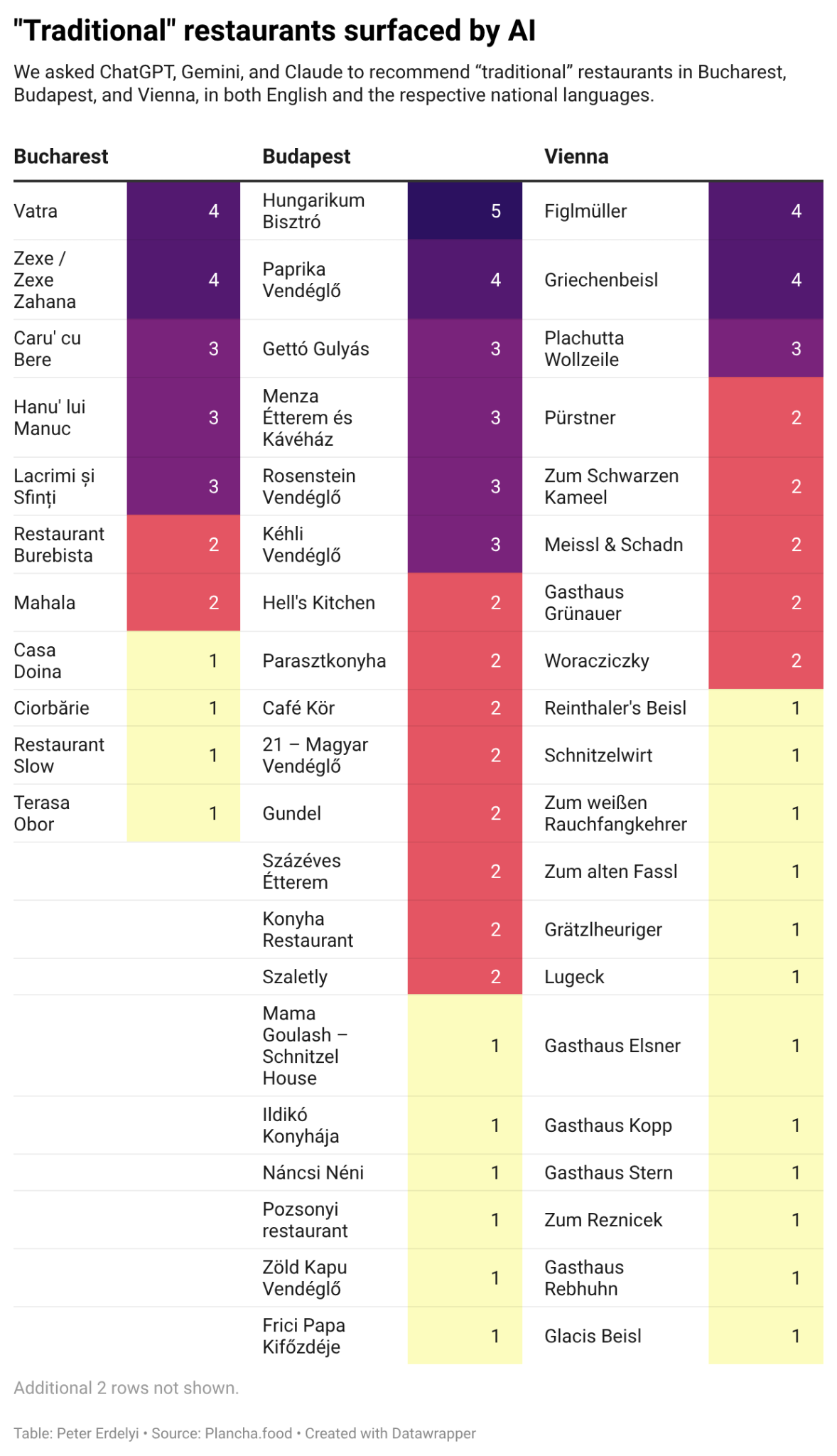
We queried ChatGPT, Gemini and Claude across our three cities: Budapest, Bucharest and Vienna. We asked for restaurant recommendations in English and in the local language. We also asked follow-up questions:
- why did you choose these restaurants,
- what sources and signals influenced the answer,
- how much weight did you give to sources like Google Maps, TripAdvisor, local media, Reddit and other signals,
- and what would change if we asked for less tourist-heavy places.
We treated language as a proxy for market segment. English prompts tend to resemble tourist discovery. Local-language prompts, and especially “not touristy” prompts, produced a different map of each city.
Here are the restaurants that did well and the signals and sources the AI models used to build their lists.
What showed up
The strongest pattern was obvious: heritage names and high-volume review machines do well.
The old names are sticky because the models can explain them easily: schnitzel authority, paprikás authority, historical inn, cultural weight. ChatGPT described this honestly: some picks were not necessarily the best food-only spots, but the best “overall traditional experiences”.
What the models said they were looking for
We asked each model two questions after it gave us their ranking:
- “Why did you choose these? Be specific about signals.”
- “Estimate the relative importance (%) of sources influencing your answer.”