§ Issues
16
Dispatches filed and counting — for the line, not the lounge.
What the planned Hungarian VAT cut won't do, what the Austrian Ministry of Agriculture got wrong, and where post-event sales actually show up.

We asked ChatGPT, Gemini and Claude where to eat in Budapest, Bucharest and Vienna, then asked them why. The answers show who is visible, who is missing, and why Google still sits underneath most AI restaurant discovery.

Three operators on how they structure midday service, who it brings in, and what it builds that dinner service can't.

Five items. Iran, influencers, toilet signs, a bakery opening, and Turkish food done right.

Food waste is one of the least-tracked costs in hospitality. Here's what the numbers look like when you measure it.

Plancha Express edition, five things worth your attention before the next service.

How soy became CEE's most complicated ingredient and what that means for your menu.
Three items before the next service:
People are asking AI where to eat. Attest’s 2025 consumer AI report found that 13.5 percent of consumers ask AI for restaurant, bar, hotel and attraction recommendations. BrightLocal’s 2026 Local Consumer Review Survey found that use of ChatGPT and other AI tools for local business recommendations jumped from 6 percent in 2025 to 45 percent in 2026.
But visibility is not trivial: Local Falcon’s restaurant study, based on 189,905 ChatGPT search results, found that 83 percent of restaurants were completely invisible on ChatGPT, compared with 14 percent on Google.
Google rankings may be crowded, incremental and annoying, but AI recommendations are narrower: five names, sometimes fewer. You are either in the answer or you are not.
So we ran a small test.
We queried ChatGPT, Gemini and Claude across our three cities: Budapest, Bucharest and Vienna. We asked for restaurant recommendations in English and in the local language. We also asked follow-up questions:
We treated language as a proxy for market segment. English prompts tend to resemble tourist discovery. Local-language prompts, and especially “not touristy” prompts, produced a different map of each city.
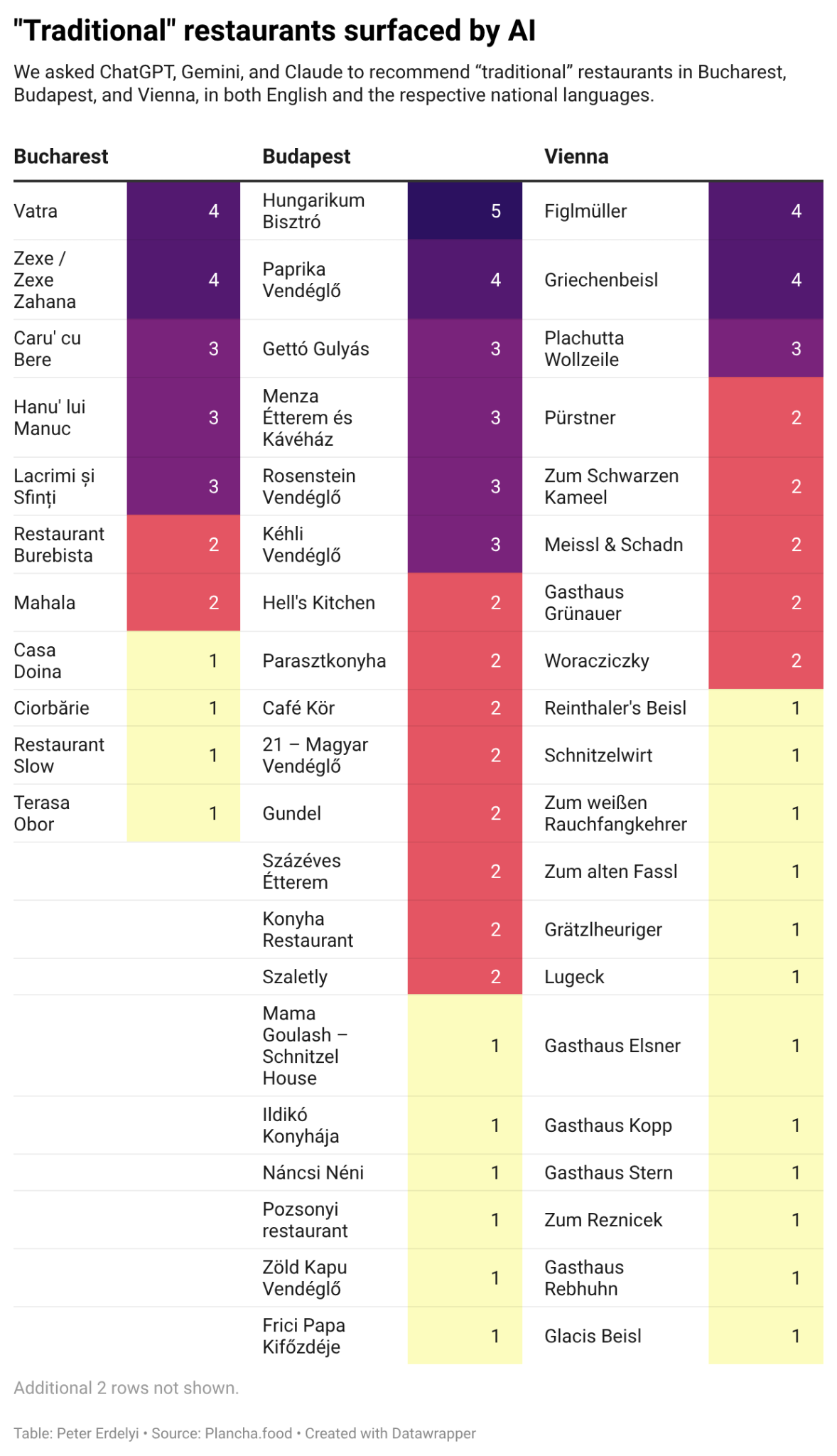
Here are the restaurants that did well and the signals and sources the AI models used to build their lists.
The strongest pattern was obvious: heritage names and high-volume review machines do well.
The old names are sticky because the models can explain them easily: schnitzel authority, paprikás authority, historical inn, cultural weight. ChatGPT described this honestly: some picks were not necessarily the best food-only spots, but the best “overall traditional experiences”.
We asked each model two questions after it gave us their ranking:
None of the three restaurants featured in this piece are running lunch to make money at noon. One hasn't calculated a break-even. Two say outright they don't expect profit. What they do have is a room that isn't empty in the middle of the day, staff who eat well, and a specific kind of regular that dinner service doesn't build. The crowds are different too, in some cases almost entirely different people, with different expectations, different price sensitivity, and a different relationship to the place. Understanding who comes for lunch, and why the kitchen bothers, turns out to say something useful about how these operations think about what they're actually for.
We spoke separately to Benjamin Hofer, co-founder of XO Grill (Vienna); Dávid Kautezky of Gettó Gulyás (Budapest); and Marius Tudosiei, owner of Băcănia Veche Delicatese și Grădină (Bucharest). The questions were largely the same.
The restaurants
What began as a Covid-era pop-up has grown into a brand with three locations across the city. The formula sounds obvious until you see how few people execute it this well: high-quality beef from old Austrian dairy cows via the parent company XO Beef, clean branding, and the discipline of doing one thing properly. Prices are ambitious (a classic smash burger runs €14.90) but that hasn't stopped XO from becoming one of Vienna's most recognizable upscale burger operations.
A classic Hungarian restaurant in the old Jewish ghetto, near the Dohány Street Synagogue, in one of the city's most tourist-saturated neighbourhoods. Like a lot of places in the area it exists largely for visitors, but with more honesty and competence than most. The menu is unapologetically traditional: gulyás, stews, paprikás dishes, classic desserts, without trying to reinvent any of it. Usually packed at dinner; reservations are a good idea. Gault Millau Hungary awarded it one hat.
Băcănia Veche Delicatese și Grădină — Bucharest
Opened in July 2021 in downtown Bucharest, part of a larger catering and grocer's company owned by former journalist Marius Tudosiei. It sits on Dacia Boulevard, one of the city's oldest commercial streets, close to Piața Romană, with a sunny walled garden and a reputation for seasonal, farm-to-table cooking. The menu leans on nostalgia - storceag (fish and sour cream soup), pork stews, borscht - but with a more urban sensibility. Prices are in line with what a bistro should charge. It draws both Romanians who know Tudosiei's work on heirloom recipes and local producers, and tourists looking for Romanian food that is authentic without being a caricature.
Why did you decide to offer a lunch menu?
XO Grill, Vienna — Benjamin Hofer
The decision came after the opening of a second branch in the 7th district, one of Vienna's more competitive dining areas. "We are definitely on the more expensive side," Hofer says.
"So at some point we realised we had to fit within the area, where right next door you can get a really good pizza for less than €10." The lunch menu, at €12.50, is a deliberate concession to context."
— Benjamin Hofer
Getto Gulyás, Budapest — Dávid Kautezky
Two reasons, in Kautezky's telling, and neither is primarily revenue. The first is marketing: keeping the room full, attracting Hungarian locals alongside tourists, and generating energy from midday. The second is practical: staff can eat, the chef can eat, and food sometimes goes home. "We don't really make money on it," he says.
"It's not typical that someone who comes for lunch returns in the evening for à la carte dining, maybe one or two examples at most. It's a different audience."
— Dávid Kautezky
Băcănia Veche, Bucharest — Marius Tudosiei
Before the pandemic, the company ran a separate lunch bistro in Bucharest's northern business district. When the restaurant opened in 2021, continuing a midday offer made sense. With one deliberate distinction: they don't call it a lunch menu. The reason is structural: in Romania, lunch tickets (a common employee benefit) are capped by law at around €9. Calling it a "lunch menu" sets a price expectation the restaurant can't meet. So they don't.
How is the menu structured, and how often does it change?
Welcome to Plancha Express, in today's edition:
The US-Israeli military operation against Iran began on February 28 and has no clear end date. Hungary, Romania and Austria are far from the conflict, but their hospitality sectors are already exposed through two channels: weaker demand and rising costs.
The first is demand. In 2024, Israeli visitors accounted for around 693,000 overnight stays in Hungary. For summer 2025, Budapest Airport had planned around 590,000 seats to Israel, part of more than 1 million seats to the Middle East (the largest such capacity in Central and Eastern Europe). With air travel in the region disrupted, a significant share of visits from the region won’t materialise, and the spending that comes with them (food, drink, transport, leisure) will neither. Uncertainty about travelling is already impacting tourism in other parts of Europe, including Cyprus and Greece.
The second is costs, starting with food. Prices are likely to rise through three main drivers. Higher oil and gas prices increase costs across farming, transport and food processing. Supply disruptions around the Strait of Hormuz push up fertiliser prices globally, raising input costs for farmers across Europe. And higher oil prices make ethanol and biodiesel more competitive, diverting crops like maize and vegetable oils away from food use. After Russia's invasion of Ukraine, the same combination drove EU food and beverage inflation above 19%.
Energy costs are moving in a similar direction. Dutch TTF natural gas futures, Europe's benchmark, rose above €65/MWh in early March, more than 50% above pre-conflict levels. Eurozone energy inflation turned positive in March at 4.9%, after –3.1% in February. For hotels and restaurants, which run kitchens, heating, cooling, laundry and lighting around the clock, this feeds directly into operating costs. The pass-through depends on contract structures and national regulation, but sustained pressure erodes those buffers.
The result is a two-sided squeeze. Operators can absorb the shock and lose margin, or pass it on and risk further weakening demand.
The same kind of pressure is already reshaping menus elsewhere. In Ukraine, one restaurant operator told The Counteroffensive that when electricity cuts hit, fryers go quiet because they use too much power, and kitchens switch to shawarma cooked on a vertical grill because it is cheaper to run. That is what cost shocks look like at ground level: not just higher bills, but operators redesigning what they serve around whatever can still be cooked affordably and reliably.
Operator take: If you haven't reviewed energy contract terms and Middle Eastern booking exposure in the last 30 days, do it this week, the cost trajectory is clear and the window to adjust ahead of it is narrowing.
This edition is about food waste not as a moral issue, but as a business one.
Most restaurants can tell you their labour cost, rent pressure, and maybe even average spend per cover. Far fewer can tell you how much food they buy and never actually sell.
The numbers are not trivial. Studies regularly estimate that 5 to 15 percent of purchased food is never served. A more concrete benchmark: the average restaurant discards 75 to 150 grams of food per cover. For a 150-cover operation, that can mean around 15 kilos a day, or more than five tonnes a year. You pay for that food when you buy it, and then often pay again to have it taken away.
We’ll look at what that waste costs, how operators in Vienna, Budapest and Bucharest are dealing with surplus, and why the first step is still the least glamorous one: measuring the problem properly.
Bread is Austria's most discarded food. Households throw away 100,000 tonnes annually, 28 percent of all food waste, narrowly ahead of fruit and vegetables. Bakeries discard an additional 52,000 tonnes of unsold goods each year.
In the premium bakery sector, waste has been reframed as part of the brand story. Öfferl and Joseph Brot, both from Lower Austria, have built high-price positioning around sustainability credentials. The practice of reworking unsold bread into new loaves is real, but it doesn't resolve the structural problem: you can only rework so much. The more scalable solutions sit a tier below. Most mass-market bakeries and supermarket bakery sections now apply evening discounts in the final half-hour. Most are also listed on Too Good To Go, Austria's dominant food-saving app. The Geier bakery – a storied brand that has reinvented itself under the same banner of sustainability – takes a variation: a bag of unsold goods in the last hour for €3.99, fifty cents of which goes to the Austrian Food Bank.
Romania's relationship with food waste is more cultural.
The Christmas-and-Easter supermarket footage, carts loaded to capacity, coverage slightly contemptuous, has been a recurring media ritual for decades. For generations who came through the food shortages of the 1980s, visible abundance is a response to scarcity. This is not static; inflation, and a younger generation that didn't experience the shortages, are changing the calculus.
Elena Soare has run Urban Dada at the National Theater in Bucharest for over a decade. She is seeing it directly: "If the event is for 40 people, they order 35 menus now." Packaging leftovers, considered faintly embarrassing five years ago, is increasingly something guests ask for themselves. Her kitchen has operated this way for years regardless: the lunch menu runs to 20 or 30 portions maximum; demand beyond that gets an equivalent dish made to order. Leftover risotto becomes arancini. Dried bread rolls become croutons.
In addition to the cultural shift, policy is also changing in Romania, restaurants have until March 31 to file food waste reduction documentation with the government or face fines of around €8,000. Around 400,000 to 450,000 entities must comply.
Albert Wettstein, co-founder of Munch (which operates in Romania under the brand Bonapp.eco) describes the contrast directly: Romania sits closer to Istanbul than Budapest in its food culture.
This time we’re trying Plancha Express: five shorter items you can read between service and payroll. Same rule as always: no fluff, no trend theatre; just things that might change how you think about menus, margins, staff, or guest experience. Hit reply and tell us which of these you want more of (and which you never want to see again).
Romanian chef and food activist Adrian Hădean opened a public debate last month with a pointed question: if Romania produces cheap wheat, why does artisanal bread cost 10 euros a kilo? He identifies two structural failures: the country exports raw grain while importing processed flour, and the state offers craft bakers almost no protection or support. Lara Schütz, an Austria-based baker and bread sommelière of Romanian origin, responded on her own Substack: wheat and flour together represent just 4 to 10 percent of a loaf's final price. The rest is processing, labour, storage, transport, and quality control. Price volatility in grain markets barely registers at the shelf. Both are making valid arguments about different things. Hădean is raising a policy question about access to food. Schütz is writing about the economics. The conversation they're edging toward but not quite having: what structural support would actually allow craft bakers to bring prices down without destroying their margins?
Operator take: If you sell bread, explain the process (time/skill), not the ingredients.
Soybeans had a PR problem. For decades in parts of Central Europe, it meant deprivation: filler in bad salami, a symbol of scarcity. Today, the same ingredient shows up as high-margin edamame in every poke bowl from Vienna to Bucharest.
We dug into 15+ years of Google Trends data to see how interest in tofu has shifted across Austria, Hungary, and Romania, and when it peaks. Demand is rising, but it's intensely seasonal. If you're planning a menu around plant-based protein, timing matters: we'll show you exactly when to put it on the menu.
It’s probably the Erste Wiener Tofu Manufaktur at the Karmeliter market. It makes tofu fresh from Lower Austrian soybeans using traditional Chinese methods, to take away or enjoy on the spot. A bowl of crisp tofu pieces in pumpkin seed oil sauce comes highly recommended.
Vienna being the tofu capital of CEE is not entirely surprising, this is the city where soybeans arrived in Europe on 1 May 1873.
That morning, thousands gathered in the Prater for Vienna's first world's fair. Among them was agriculturalist Friedrich Haberlandt, who made straight for the Japanese and Chinese pavilions. Alongside lacquerwork and porcelain, these nations had brought something few Europeans had encountered: soybeans. Haberlandt was searching for inexpensive ways to improve the empire's nutrition. He planted his first seeds in a university garden in central Vienna. Before long, soy would spread across the continent.
But soy's journey through Central Europe hasn't been straightforward.
In Romania, "You never had to eat soy salami" remains a reproach that survivors of Communist food scarcity throw at those who didn't live through it.
In the 1980s, when the country was exporting everything to pay external debts, the few foods available were pseudo-charcuterie made from pink slime and soy. The ingredient became synonymous with hunger and dictatorship.
Its redemption arrived through the church.
After 1989, religious practices suppressed under communism returned, including the strict Orthodox fasts. When Romanians fast for Christmas and Easter, they go full vegan: no meat, eggs, or dairy. Tofu became a way to keep traditions while eating something beyond potatoes and beans.
Today, ramen places, sushi counters, and salad bars all display edamame. It's exotic. It's expensive. It's soy (even if most people have no idea).
Taste, both biological and moral, is highly susceptible to the effects of context, which shapes perception. “In this case,” says anthropologist Adriana Sohodoleanu, “the context is created by placing the food within different logics: soy salami belonged to the logic of the rational diet promoted by a duplicitous political regime that lacked legitimacy and consumers’ trust; soybeans/edamame, on the other hand, fit into the logic of cool consumption, the kind that constructs and sustains social identities.”
We tracked 15 years of Google search data across Austria, Hungary, and Romania and the seasonal pattern has direct implications for your menu planning.
For people who run restaurants, hotels, and hospitality businesses in Central Europe.